
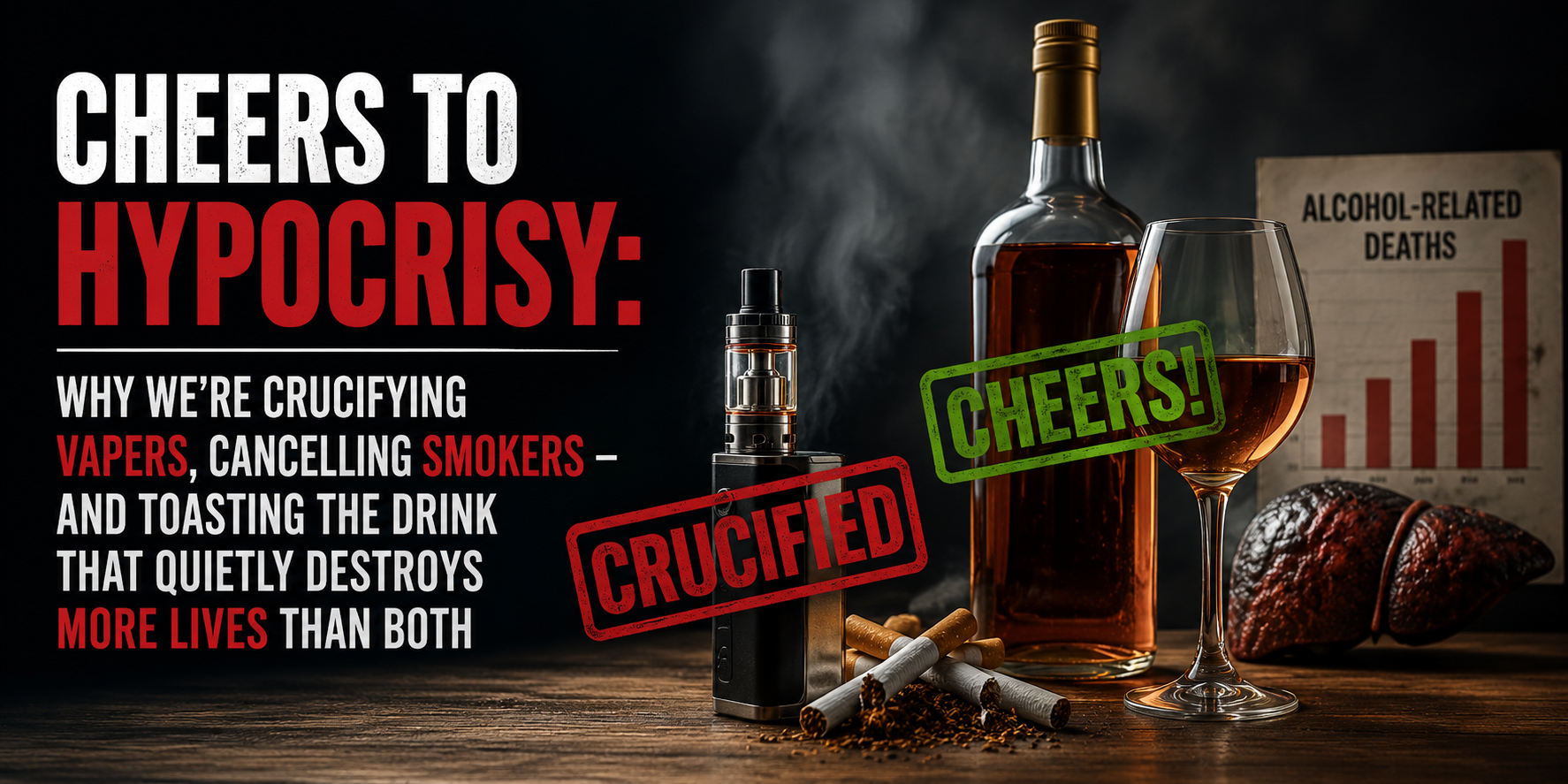
Why We’re Crucifying Vapers, Cancelling Smokers — and Toasting the Drink That Quietly Destroys More Lives Than Both
A personal take on smoking, vaping and alcohol — and the double standard nobody on social media wants to talk about.
I smoked for twenty years. Twenty. The morning cough, the heavy chest, the smell that clung to clothes and curtains and skin no matter how many showers or perfumes I threw at it. I knew exactly what it was doing to me. I just couldn’t stop.
Then, about fifteen years ago, I switched to vaping. The cough faded. My lungs started feeling like lungs again. I could climb stairs without my chest reminding me of every cigarette I’d ever lit. I’m not going to pretend vaping is a multivitamin — it isn’t, and I’ve never claimed it is. But the difference in how my body feels, every single day, is impossible to argue with.
So when I open Facebook, Instagram or TikTok and see another wave of posts screaming that vaping is “worse than smoking” or “killing our kids,” something in me snaps. Not because I think vaping is harmless. Because of what I don’t see scrolling past in the same feed: any of that energy aimed at alcohol — the substance that quietly causes more violence, more road deaths, more broken families and more wrecked judgement than tobacco and vapour combined, while paying for prime-time TV adverts on the way.
This is the conversation I think we need to have honestly. Not as an ad for vaping. Not as a defence of smoking. But as an adult, evidence-based look at three legal products — smoking, vaping and alcohol — and the strange selective outrage we’ve built around them.
The advertising Double Standard
Let’s start with what you see and what you don’t.
In South Africa, the Tobacco Products Control Act of 1993 bans tobacco advertising and sponsorship in essentially every form — direct, indirect, billboards, sports, point-of-sale, the lot. Under the Tobacco Products and Electronic Delivery Systems Control Bill (still working its way through parliament as of late 2025), vaping is set to be treated exactly the same. No adverts. No sponsorships. Plain packaging. The full package.
Now compare that with what governs alcohol. The Liquor Act of 2003 says alcohol adverts can’t be “false or misleading” or target minors, and that’s largely the end of it. Beer, wine and spirits brands sponsor cricket. They sponsor rugby. They sponsor music festivals, soap operas, social media influencers and award ceremonies. A draft Liquor Amendment Bill that proposed restrictions on alcohol marketing has been kicking around since 2017 and has been steadily watered down or shelved every time it gets close to a vote.
Read that again. The two industries blamed most loudly for endangering young people — tobacco and vaping — are legally forbidden from advertising. The industry whose product is implicated in roughly 7% of all deaths in this country buys ad space on the side of the road, on your favourite sports jersey, and between every news bulletin.
It is not a conspiracy theory to notice this. It is just literacy.
“Vaping is worse than smoking” — what does the science actually say?
Let me say this plainly: the line that vaping is worse than, or even equal to, smoking has no serious scientific evidence behind it. None. The big independent reviews — the people who do nothing else for a living except look at this data — have landed somewhere very different.
The UK’s Royal College of Physicians, in its 2024 evidence review titled E-cigarettes and harm reduction, concluded that vaping carries only a small fraction of the risk of smoking over the short and medium term. They were also clear that it is not risk-free, and that we still need more long-term data. That is a fair, honest scientific position — and it is the opposite of “worse than smoking.”
Public Health England’s landmark 2015 review put the figure at around 95% less harmful than smoking. That number gets criticised, fairly, for resting on expert estimates rather than decades of mortality data we simply don’t have yet. But every subsequent biomarker study — measuring the actual toxic and carcinogenic chemicals in people’s bodies — has pointed in the same direction: vapers are exposed to far lower levels of the substances that kill smokers.
The most recent Cochrane review of e-cigarettes for smoking cessation (Lindson et al., 2024) included 104 studies and over 30,000 participants. It found high-certainty evidence that nicotine vapes help more smokers quit than traditional nicotine replacement therapy. High certainty. That’s about as strong as Cochrane language gets.
None of this means vaping is good for you. It means that, for an adult who already smokes, switching to vaping is overwhelmingly likely to be a step toward less harm, not more. After fifteen years of doing exactly that, I am — to my own surprise — a walking case study.
Smoking: still a killer, but no longer in the spotlight
Just to be very clear: nobody in this article is defending cigarettes.
Globally, the World Health Organization estimates that tobacco kills more than 8 million people every year. Over 7 million die from direct use; roughly 1.3 million die from second-hand smoke. Around 80% of the world’s 1.3 billion tobacco users live in low- and middle-income countries — including ours.
In South Africa, adult smoking prevalence sits around 15%, with some estimates pushing higher when you include all tobacco products. Statistics South Africa-linked analyses put tobacco-attributable deaths somewhere between 50,000 and 84,000 South Africans a year. Lung cancer, heart disease, COPD, stroke — the usual horror show.
These numbers are awful. They are also, in many countries, finally trending down — because of decades of education, advertising bans, tax increases and, increasingly, the availability of less harmful alternatives like vapes. Lumping vaping in with smoking, or banning the alternative more aggressively than the original, risks undoing some of that progress.
Alcohol: the elephant in every braai, bar and boardroom
Now the part of the conversation we never seem to have.
Worldwide, the WHO’s most recent Global Status Report on Alcohol and Health attributes 2.6 million deaths a year to alcohol — about 4.7% of all deaths on the planet. Roughly 400 million people are estimated to live with an alcohol use disorder. Globally, 23.5% of 15- to 19-year-olds are already current drinkers.
South Africa’s numbers are, frankly, jaw-dropping. The South African Medical Research Council estimated that between 27,000 and 103,000 South Africans die every year because of alcohol — that’s somewhere between 74 and 282 people a day. One in ten deaths in this country is alcohol-linked. Alcohol-attributable harm has been calculated at around 7.1% of all deaths and 5.6% of all disability-adjusted life years.
Then there is the texture of those deaths. Alcohol is implicated in:
- Roughly half of all road fatalities — and our road death rate is already nearly double the global average.
- Around 12.8% of disability-adjusted life years lost to interpersonal violence — including a documented role in driving the frequency and severity of gender-based and intimate-partner violence.
- Significant chunks of TB (22.6%) and HIV (16%) disability-adjusted life years — alcohol weakens immunity, drives risk behaviour, and undermines treatment adherence.
- Cardiovascular disease, cancer, cirrhosis and a long tail of chronic illness.
Among South Africans who actually drink, average pure-alcohol consumption is around 29.9 litres per person per year — the sixth-highest in the world. About 48% of male drinkers and 32% of female drinkers binge drink. The South African Medical Research Council and various GDP-impact studies estimate the total economic cost of alcohol harm at somewhere between 10% and 12% of GDP.
Pause on that. The product whose adverts dominate your TV and stadium hoardings is costing us, conservatively, more than a tenth of our entire economy in healthcare, policing, lost productivity, and prematurely ended lives.
I won’t go into the personal detail here, but I have seen what alcohol does to families up close. I have seen judgement evaporate. I have seen love turn to fear at a sound at the front door. I have seen good people make decisions, while drunk, that they will never be able to take back. If you’ve lived in this country for any length of time, you’ve probably seen it too.
“But the youth!” — yes, all of it
A huge driver of the current panic around vaping is concern about young people. And it is a real concern. A 2025 University of Cape Town study published in The Lancet’s eClinicalMedicine — surveying more than 25,000 high schoolers — found nearly 17% of learners currently vape. Among matric pupils the average is around 30%, with some schools hitting 46%. Almost 38% vape daily. Nearly half reach for a vape within an hour of waking up. About 12% say they cannot get through a school day without one.
Those numbers are alarming. They need a serious regulatory response — proper age-gating, controls on flavours and marketing aimed at minors, education, and easy access to support for kids who are already dependent.
But here’s what gets lost in the headlines: the same young people are also drinking, and earlier than ever. Roughly a quarter of 15- to 19-year-olds globally are current drinkers. In South Africa, surveys have repeatedly shown that the average age of a young person’s first drink is now around 12 or 13. Among adolescents who do drink, binge-drinking patterns mirror the adults around them. They smoke hookah at restaurants. They drink at house parties their parents partially fund. They use cannabis. They mix things.
If we are genuinely worried about youth health, we cannot keep building campaigns that demand kids put down the vape while we hand them a beer at the next family braai. They are watching. They notice.
Where personal choice fits in
Adults are not children. That is supposed to be a feature of a free society, not a bug.
Once you are old enough to vote, sign a lease, marry, take on debt and go to war for your country, you are old enough to decide what you put into your own body — provided you understand the risks and you are not harming anyone else. We accept this principle for alcohol, even though alcohol is, by almost every credible measure, more dangerous to the user and to bystanders than nicotine in any form. We accept it for sugar, ultra-processed food, extreme sports, casual sex, motorcycles and a thousand other things that quietly kill more people than vaping ever will.
That is not an argument for indifference. It is an argument for consistency.
If we want to treat vaping like a public health issue, then by every yardstick we use, alcohol deserves a louder, harsher, more sustained campaign. If we want to leave alcohol alone because adults are entitled to enjoy a glass of wine with dinner, we cannot in the same breath treat an ex-smoker who switched to a vape like a criminal.
What I’m actually asking for
I’m not asking anyone to take up vaping. I’m not asking anyone to defend the tobacco industry, which spent decades lying to people who looked exactly like me. I’m certainly not asking for less honesty about the real, ongoing risks of nicotine — including for young people who never smoked in the first place.
I’m asking for three things.
First: tell the truth about the evidence. “Vaping is worse than smoking” is not a scientific position. It is a slogan. Every major independent review says otherwise. Pretending it’s a settled question that has gone the other way doesn’t protect kids; it just confuses ex-smokers who are trying to stay quit.
Second: be consistent. If we are going to ban every advert for tobacco and vaping in the name of public health, then alcohol — which kills more South Africans, breaks more families and costs our economy more every single year — must be held to at least the same standard. Either restrict all three, or be honest about the fact that we tolerate the deadliest of the three because we like it.
Third: respect adults. People who choose to drink, smoke, vape, or do none of those things, are not stupid. They are not lost. They are not your project. They are making their own calls with their own bodies and their own lives. The most powerful thing public health can do is give them accurate information and easy access to help when they want it — not lecture, shame, ban, post and repeat.
I smoked for twenty years. I have vaped for fifteen. I have watched alcohol do things, in this country, that no amount of soft-focus advertising can disguise. From where I’m sitting, the war on vaping looks less like a public health crusade and more like a convenient distraction — one that lets us feel virtuous on social media while the bottle on the table keeps quietly winning.
Maybe it’s time we put that bottle in the headline for once.
Selected sources and further reading
- World Health Organization — Tobacco fact sheet and Global Status Report on Alcohol and Health (latest editions).
- South African Medical Research Council — Estimating the burden of alcohol abuse in South Africa.
- Royal College of Physicians — E-cigarettes and harm reduction: an evidence review (2024).
- Cochrane Review (Lindson et al., 2024) — Electronic cigarettes for smoking cessation.
- University of Cape Town / The Lancet eClinicalMedicine (2025) — Adolescent e-cigarette use in South Africa.
- Tobacco Atlas — South Africa country fact sheet.
- Tobacco Products Control Act, 1993; Liquor Act, 2003 (South Africa).



Leave A Comment